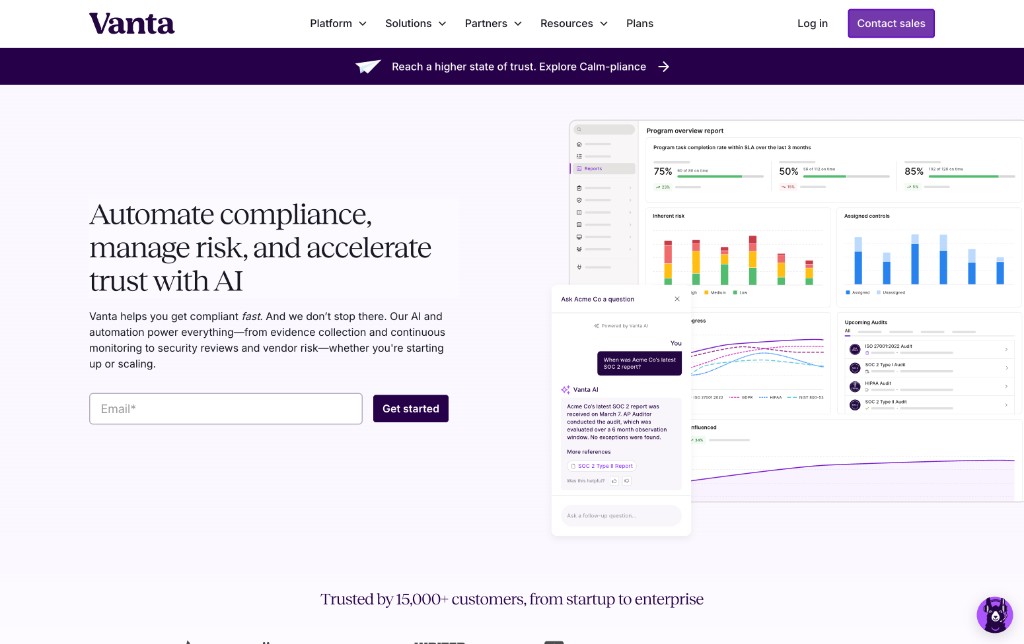
Vanta helps over 15,000 companies manage compliance across dozens of frameworks and hundreds of integrations. That kind of product surface means the team is constantly shipping new workflows, from access reviews to vendor risk to trust reporting.
The Problem
Before Magic Patterns, the path from product idea to something engineers could build against took roughly two weeks. A PM would write a PRD, sketch a few ideas, then wait for design to turn those into mockups. By the time designs came back, the team had often debated the idea in the abstract or lost some of the original context behind the idea.
"With other prototyping tools, I’d upload a low-fidelity mockup and it would just be boxes and circles. I spent all my time trying to make it look like our actual product. Magic Patterns lets me explore new ideas quickly and it actually looks like a Vanta feature."
Erika Hairston, a Senior PM on the Personnel team, felt this gap acutely. Her team had one designer supporting 13 engineers.
She tried using other AI prototyping tools to move faster. They were slow and produced generic outputs that didn’t resemble Vanta’s product. Instead of exploring new ideas, she was stuck trying to clean up what the tools generated.
Working Through Ideas Faster
Erika’s goal is simple. She wants to see what a workflow looks like while she is still thinking through the problem. With Magic Patterns, she can do that in seconds.
Magic Patterns focuses exclusively on frontend UI generation, a deliberate choice that resonated immediately with Erika. She can generate multiple versions of an idea in one sitting using the /Inspiration command, compare them, and refine her thinking before looping in her design partner for refinement.
By using screenshots of existing pages and building on Vanta’s design system, the prototypes come out polished and on-brand from the first pass.
PMs Bring Options, Not Ideas
When the team has an idea for a new feature, a PM writes a few sentences describing the problem and a rough solution, screenshots the page the feature will live on, and feeds both into Magic Patterns. The tool replicates the existing page using Vanta's components, then the PM uses natural language to generate multiple UX variations of the same problem and iterate.
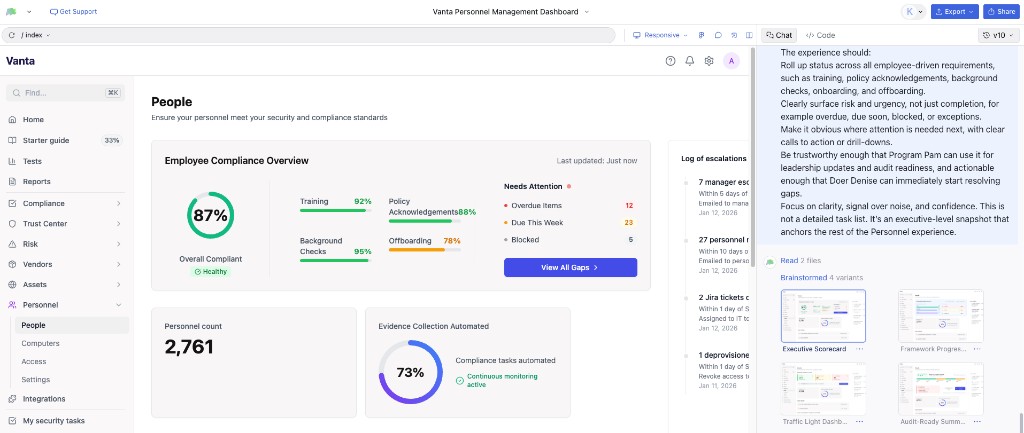
Erika utilizing the /Inspiration command to brainstorm variants
The designer no longer starts from scratch. By the time they get involved, the PM has already chosen a direction, so they can go straight into refinement.
"I love how our product team can build reusable components that are already based on our design system. By the time a prototype reaches me, the fidelity is close enough that I can focus on refinement rather than rebuilding from scratch."
Resolving Build Decisions in Hours, Not Weeks
When Erika's team was building a new AI-powered account detection feature, they hit a fundamental design question: should this be a chat interface embedded in an existing workflow or a standalone page?
Erika built both versions in Magic Patterns in about an hour.
She walked the team through each option in a single meeting. They chose the embedded workflow and moved straight into build. The feature shipped end-to-end in seven weeks.
Impact
Vanta PMs no longer wait for the design cycle to produce an artifact that engineering can react to. Instead, they generate one themselves that's close enough to the real product to drive alignment. Designers spend less time on exploratory mockups and more time on the systems-level refinement that actually requires their expertise. Engineering gets aligned earlier because the team converged on a visual artifact before a single line of code was written.
As Erika puts it: "I never want design or product to be the bottleneck. Magic Patterns is the tool that gets an artifact in our engineers' hands as quickly as possible."